

Hair loss is one of the most emotionally difficult experiences a person can face and it is far more common than most people openly acknowledge. For residents of Tamil Nadu’s capital, finding the right hair regrowth treatment Chennai clinics offer has become an increasingly urgent priority driven by rising awareness and by the growing availability of clinically validated, non surgical options that were not accessible a decade ago.
Chennai presents a uniquely challenging environment for hair health. Its coastal humidity, hard water supply, high ambient temperatures, and the demanding professional lifestyle of its urban population place hair follicles under consistent physiological stress. Understanding these city specific triggers alongside the biological mechanisms of hair loss is the essential first step before any hair regrowth treatment Chennai plan can be meaningfully designed.why hair loss is particularly challenging in Chennai, which treatments specialists now have access to, and how to build a long term plan that delivers and sustains visible results for both men and women.
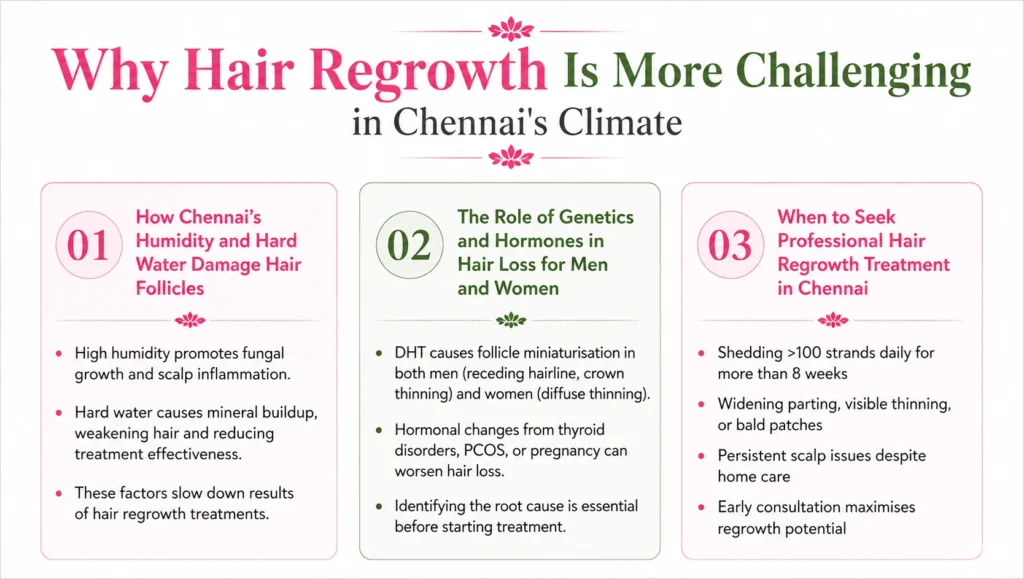
Hair loss is rarely caused by a single factor. In Chennai, the environment itself amplifies many of the biological and genetic vulnerabilities that drive follicle deterioration. Before choosing any hair regrowth treatment Chennai residents should first understand the specific local and physiological factors working against them.
Chennai’s combination of climate stress, water quality issues, and high-pressure lifestyle creates a compounding burden on the scalp that most cities do not share to the same degree. Addressing these environmental contributors is foundational topical treatments and clinical procedures that work well elsewhere may underperform here if local triggers are not simultaneously managed. An effective hair regrowth treatment Chennai plan must therefore be designed with the city’s specific conditions in mind, not simply transplanted from a generic protocol developed for a different climate and demographic.
Chennai’s relative humidity remains high for the majority of the year, particularly during the north east monsoon. Prolonged high humidity creates a warm, moist scalp environment in which the Malassezia fungus responsible for dandruff and seborrhoeic dermatitis thrives. Chronic fungal scalp conditions produce persistent inflammation around the follicle opening that weakens structural integrity and reduces the follicle’s ability to sustain active hair growth.
Hard water is the second major aggressor. Chennai’s municipal supply carries elevated calcium and magnesium ions that deposit on the hair shaft and scalp surface with every wash. Over time, this mineral buildup makes the shaft brittle, disrupts scalp pH, and reduces the effectiveness of medicated shampoos. Many patients pursuing hair regrowth treatment Chennai clinics see slower initial results specifically because hard water undermines topical treatment protocols between appointments.
The most prevalent form of hair loss in both genders is androgenetic alopecia driven by dihydrotestosterone (DHT), an androgen that progressively miniaturises genetically susceptible follicles, producing hair that becomes shorter and finer until the follicle stops producing visible growth altogether. In men, this presents as a receding hairline and crown thinning following the Norwood scale. In women, it appears as diffuse thinning across the crown following the Ludwig classification, with the hairline generally intact.
Hormonal fluctuations including thyroid disorders, polycystic ovarian syndrome (PCOS), and post pregnancy oestrogen withdrawal frequently accelerate the genetic predisposition in women. These hormonal dimensions must be identified and addressed before any hair regrowth treatment Chennai plan can produce its full potential.
Knowing when to transition from home care to clinical intervention is one of the most consequential decisions in the hair loss journey. Many people wait too long hoping shedding will self resolve while follicles continue to miniaturise, closing the window for non surgical regrowth.
Clear signals that professional hair regrowth treatment in Chennai is warranted include: shedding more than 100 strands daily for over eight weeks, a visibly widening hair parting, thinning confirmed in photographs taken three to six months apart, sudden patchy bald spots, or a scalp that is persistently flaky or inflamed despite medicated shampoo use.
Example:
Civil engineer from Chromepet noticed his hairline receding at both temples over 18 months. He self-treated with coconut oil and biotin supplements for over a year without improvement. By the time he visited a clinic, a scalp analysis confirmed Grade III androgenetic alopecia. Despite the delay, a targeted hair regrowth treatment Chennai plan combining topical minoxidil, oral finasteride, and six PRP sessions produced measurable hairline improvement within seven months. His trichologist noted that earlier presentation could have yielded significantly more complete results. Early professional consultation is always the single most important factor in successful hair regrowth treatment Chennai outcomes.
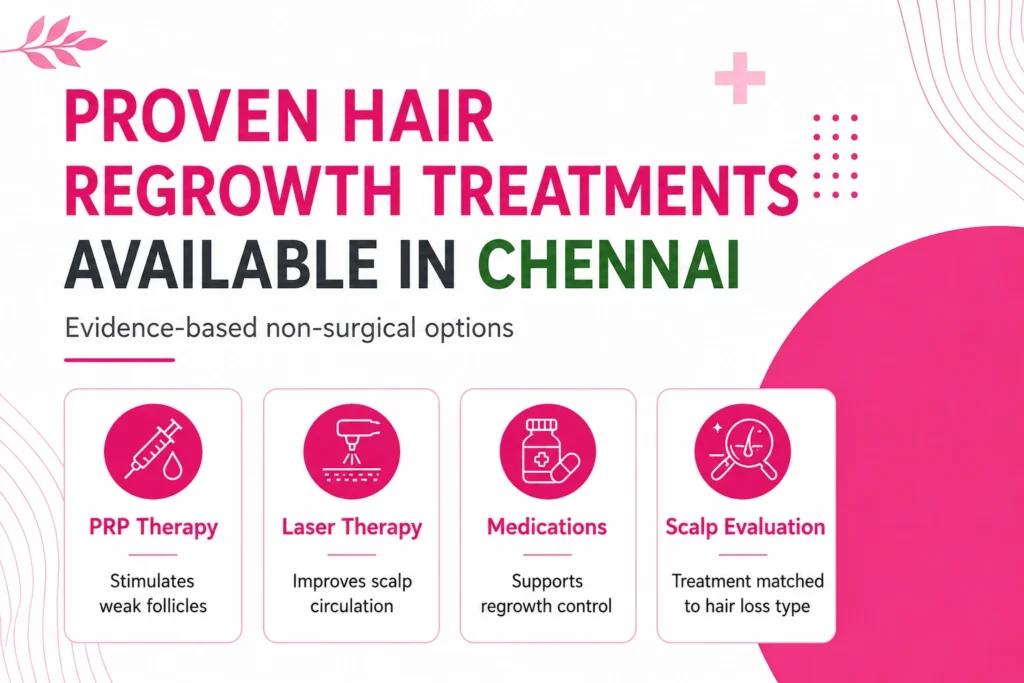
Chennai is home to a growing number of clinically equipped dermatology and trichology centres offering evidence based, non surgical hair regrowth options. The best hair regrowth treatment Chennai clinics provide is always individually prescribed never a one size fits all package. The type of hair loss, its severity, the patient’s age, hormonal profile, and scalp condition all determine which combination of treatments will yield the most reliable outcome. Understanding what each treatment does and which patient profiles it suits best is essential before committing to any protocol. The following section provides a factual overview of the most validated hair regrowth treatment Chennai options currently available.
Platelet-Rich Plasma (PRP) therapy is one of the most widely adopted hair regrowth treatment Chennai clinics offer. The procedure draws a small volume of the patient’s own blood, centrifuges it to concentrate the platelet fraction, and injects the growth factor rich plasma directly into the scalp at follicle level. Growth factors within PRP including PDGF, VEGF, and IGF stimulate dormant follicles, prolong the anagen growth phase, and improve scalp vascularity. A peer-reviewed study on PubMed examining PRP for androgenetic alopecia confirmed statistically significant improvement in hair density and thickness following treatment.Mesotherapy complements PRP by delivering a customised cocktail of vitamins, minerals, and follicle stimulating peptides directly into the scalp’s mesoderm layer via microinjections achieving concentration levels at the follicle that oral supplementation cannot match.
| Treatment | Mechanism | Ideal Candidate | Sessions Required | Downtime |
| PRP Therapy | Growth factors reactivate dormant follicles | Early to mid-stage androgenetic alopecia | 4–6 sessions, 4 weeks apart | None |
| Mesotherapy | Targeted nutrient delivery to follicle level | Diffuse thinning, nutritional deficiency hair loss | 6–8 sessions, 2–3 weeks apart | Minimal redness, 24 hrs |
| Low-Level Laser Therapy | Photobiomodulation improves follicle metabolism | Mild to moderate thinning, maintenance | 2–3 sessions per week, 12–20 total | None |
| Microneedling | Micro-channels enhance topical absorption | Combined with PRP or serums | Monthly, 6–8 sessions | 24–48 hrs redness |
| Topical Minoxidil | Vasodilation prolongs anagen phase | Male and female pattern hair loss | Daily, ongoing | None |
Low-Level Laser Therapy (LLLT) uses red light wavelengths of 630 to 670 nanometres to stimulate cellular energy in follicle cells through photobiomodulation, improving blood circulation and reducing oxidative stress on the follicle. Clinical research on the NIH database on LLLT for hair loss confirms significant improvement in hair density and tensile strength with no adverse effects making it a safe and effective component of any hair regrowth treatment Chennai protocol.
Scalp microneedling creates controlled micro-injuries on the scalp that trigger the body’s wound-healing response, stimulating collagen production and growth factor release around the follicle. It also dramatically increases penetration of topical agents such as minoxidil a 2013 study found that minoxidil combined with microneedling produced three times greater hair count improvement than minoxidil alone.
Ayurvedic protocols form an important layer of hair regrowth treatment Chennai plans both as a standalone approach for mild cases and as a complementary home protocol alongside clinical sessions. Bhringraj oil, prepared from Eclipta alba, is the cornerstone herb. Twice-weekly scalp massage with Bhringraj improves circulation, reduces inflammation, and has been shown to extend the anagen phase. Amla oil’s 5-alpha reductase inhibitory properties offer a natural DHT-blocking mechanism. Brahmi oil supports root anchoring and reduces stress-related follicle suppression. The American Academy of Dermatology’s hair loss treatment guide acknowledges the growing evidence base for botanical treatments as part of a comprehensive care plan.
Example:
School teacher from Nungambakkam experienced diffuse crown thinning following thyroid-related hair loss. After her thyroid was stabilised medically, she began a combined hair regrowth treatment Chennai plan: monthly PRP sessions in clinic alongside twice-weekly Bhringraj and Amla oil massage, a protein-rich diet, and a sulphate-free herbal shampoo at home. The clinical and natural layers worked synergistically PRP stimulated follicles from within while the Ayurvedic oils reduced scalp inflammation between sessions. By month six, her crown parting had visibly narrowed and trichoscopy confirmed new growth. Her case illustrates the most effective approach: clinical hair regrowth treatment Chennai combined with a structured natural home protocol.
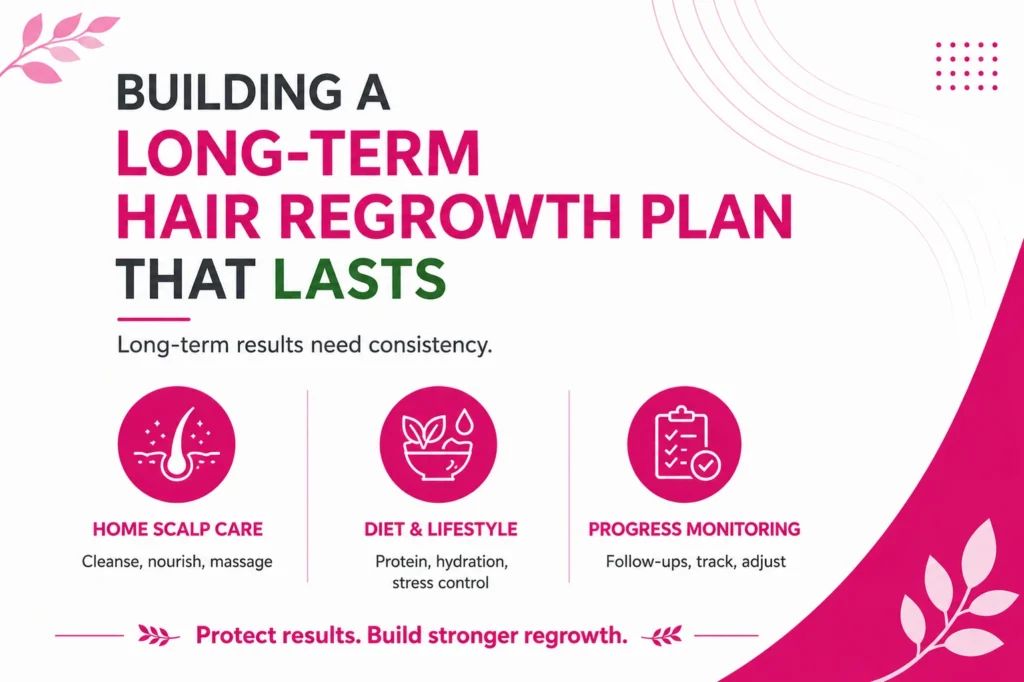
Beginning a hair regrowth treatment is only the first step. The real differentiator between patients who sustain results and those who regress is the quality and consistency of the long-term plan that follows. Hair regrowth treatment Chennai specialists consistently emphasise that clinical sessions alone without structured home care and regular follow-up rarely produce durable outcomes.
A successful long-term plan operates across three dimensions: ongoing scalp care at home, dietary and lifestyle habits that sustain follicle health from within, and objective monitoring that allows the plan to evolve as the hair responds. When all three are maintained, the results achieved through hair regrowth treatment Chennai sessions are protected and built upon rather than gradually reversed.
Consistent scalp care between clinical sessions preserves the follicle stimulation received in clinic. A home routine should include a minimum of two oil massage sessions per week using Bhringraj, sesame, or a blended Ayurvedic formula appropriate to the scalp type.
Apply warmed oil to sectioned hair using firm fingertip circular motions across the full scalp, with focused attention on thinning zones. Leave the oil for at least one hour overnight under a cotton cap is optimal. Rinse with a sulphate-free shampoo to avoid stripping the scalp’s natural sebum. Between washes, avoid tight hairstyles that create traction stress on already weakened follicles, and minimise heat styling which compounds shaft damage.
No hair regrowth treatment Chennai plan can fully overcome chronic nutritional deficiency. The follicle demands continuous protein, iron, zinc, Vitamin D3, and omega-3 fatty acids to maintain its growth phase. When any falls below threshold, the follicle reduces output or enters premature rest.
| Nutrient | Best Local Food Sources | Hair Regrowth Role |
| Protein | Toor dal, rajma, eggs, curd, fish | Builds keratin — the structural protein of every hair strand |
| Iron | Drumstick leaves, spinach, pomegranate, rajma | Delivers oxygen to follicles; prevents stress-induced shedding |
| Zinc | Sesame seeds, pumpkin seeds, cashews | Supports follicle repair, regulates scalp oil production |
| Vitamin D3 | Egg yolk, fortified milk, morning sunlight | Activates follicle receptors; supports new follicle formation |
| Omega-3 Fats | Flaxseeds, walnuts, chia seeds, mackerel | Reduces scalp inflammation, improves strand density |
| Biotin | Sweet potato, almonds, sunflower seeds | Sustains keratin infrastructure and follicle metabolism |
Lifestyle adjustments that directly support results include: seven to eight hours of sleep nightly, daily stress management through yoga or walking, avoiding smoking and limiting alcohol which depletes zinc and disrupts hormonal balance.
Systematic progress monitoring is the most overlooked component of hair regrowth treatment Chennai plans. Without documentation, it is nearly impossible to distinguish genuine regrowth from day-to-day variation and most patients underestimate their progress, losing motivation and discontinuing treatment prematurely.
Photograph the crown, temples, and hairline under identical lighting every four weeks. Keep a brief hair diary tracking shedding and scalp condition. Schedule trichoscopy assessments with your specialist every three months clinical comparison of follicle density at marked points provides the most objective measure of response available.
Example:
Marketing director from Anna Nagar completed a six-session PRP course as her primary hair regrowth treatment Chennai plan. Delighted with month-six results, she discontinued both her home oil routine and quarterly clinic visits. By month fourteen, crown thinning had visibly returned. Trichoscopy confirmed follicle density had regressed by 30 percent from her post-treatment peak. Her trichologist placed her on biannual PRP maintenance, reinstated her Bhringraj oil routine, and addressed a newly detected Vitamin D3 deficiency. Within two maintenance cycles, density recovered to its post-treatment level. Her experience defines the most important lesson in hair regrowth treatment Chennai: results are a condition that must be actively maintained, not a one-time achievement.
Hair regrowth is entirely achievable for both men and women when the right combination of clinical treatment, natural scalp care, and nutritional support is consistently in place. The best hair regrowth treatment Chennai offers is not a single procedure it is a personalised, multi-layered plan tailored to your specific hair loss type, scalp condition, and lifestyle. The earlier you begin, the more follicles remain available to respond. Whether you are in the earliest stages of thinning or have managed hair loss for years, there is a clear clinical path forward and Chennai’s trichological care landscape is fully equipped to guide you along it.
The best treatment depends on the cause of hair loss. Scalp analysis helps decide whether someone needs dandruff control, nutrition support, PRP, laser therapy, natural scalp care, or medical treatment.
Most people notice reduced shedding within a few months. Visible regrowth may take 4–6 months or longer depending on follicle health and consistency.
Yes. Dandruff can irritate the scalp, increase inflammation, and weaken follicles if ignored for a long time.
Yes. Stress can disturb the hair growth cycle and increase shedding. Stress control often improves treatment response.
PRP may help suitable candidates by stimulating weak follicles. A specialist should check scalp condition before recommending it.
Yes. Men and women often have different hair loss patterns and causes, so personalized treatment works better.
Yes. Protein, iron, zinc, Vitamin D, and B vitamins support healthy follicles and stronger hair growth.
Hard water may leave mineral residue on the scalp and hair, causing dryness, rough texture, breakage, and irritation.
Natural treatments can support scalp health and strengthen roots. They work best when follicles are active and the cause of hair loss receives proper correction.
Treatments often fail due to wrong diagnosis, inconsistency, poor nutrition, stress, untreated dandruff, or stopping treatme